
In defense modernization, bridging the gap between breakthrough ideas and deployable systems is risky under rigid procurement. Other Transaction Authorities (OTAs) provide a gateway, allowing the Department of Defense to sidestep certain traditional acquisition constraints, especially during prototyping and scaling to production.
When used correctly, OTAs can compress timelines, reduce administrative burden, and attract nontraditional partners, while still maintaining necessary oversight. Below, we unpack how OTAs operate in the prototyping-to-production flow and what makes them effective (or risky) in defense programs.
The Statutory Foundation
OTAs derive authority from the U.S. Code. For defense purposes, two key statutes apply:
- 10 U.S.C. § 4022 authorizes Prototype OT agreements for projects directly relevant to DoD systems.
- Follow-on Production OT authority (when certain conditions are met) allows the government to transition from prototype to deployment without recompeting under the FAR. GovCon +3AcqNotes+3AiDA+3.
To use an OTA, the agreement must satisfy specific statutory criteria. For example, at least one nontraditional defense contractor must participate to a “significant extent” (or meet cost-sharing or exceptional-circumstances thresholds). Dau.edu+3AiDA+3AcqNotes+3
Agencies must also adhere to oversight mechanisms (e.g., Comptroller General access for high-value awards) even when avoiding many FAR requirements. ARPA-H+2Acquisition.gov+2
From Prototype OTA to Production OTA: The Workflow
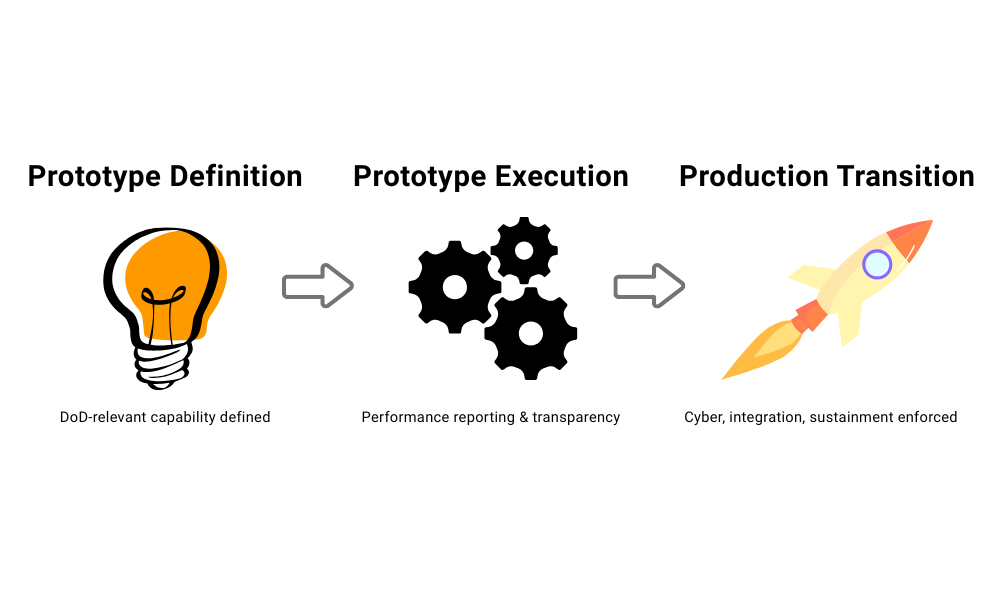
Selecting and Structuring the Prototype Phase
The first step is defining the prototype project. The work must be directly relevant to a DoD capability, system, or component that may later transition to production. Dau.edu+3ARPA-H+3Acquisition.gov+3
The solicitation or OTA agreement should explicitly state that a follow-on Production OTA (or contract) is possible if the prototype meets success metrics. AiDA+2Acquisition.gov+2
During this phase, the government negotiates terms: pricing, deliverables, IP rights, milestones, and compliance expectations. The flexibility of an OTA allows parties to tailor terms in ways that traditional FAR contracts rarely permit. Acquisition Innovation+2Acquisition.gov+2
To the maximum extent practicable, competition should be used in selecting awardees, even though OTAs permit flexibility in evaluation procedures. Acquisition.gov+2Dau.edu+2
Executing the Prototype Phase
Once awarded, the prototype agreement is monitored against milestones and outcome metrics. Reporting, transparency, and performance tracking are essential. The government often reserves rights for audits or inspections, especially on agreements exceeding certain thresholds. AcqNotes+3Acquisition.gov+3Dau.edu+3
During execution, the OTA environment may allow change management, interim payments, or more flexible financial terms not bound by all standard contract clauses. Acquisition Innovation+1
If multiple prototypes compete (a “fly-off”), the government may compare performance, cost, and risk to select a winner for production transition. Acquisition Innovation+1
Transitioning to Production
If the prototype exceeds its performance targets and meets the government’s criteria, the parties may move into a Production OTA (or a production contract) without a full recompete, provided the original agreement satisfied statutory conditions. Dau.edu+3AiDA+3Acquisition.gov+3
Production OTAs are restricted to participants in the prototype, so new bidders typically cannot join. AiDA+2AcqNotes+2
The production agreement must still align with compliance requirements, cyber posture, systems integration, and sustainment considerations. Because the stakes are higher, stricter oversight, audits, and accountability play a larger role in the production phase. Acquisition.gov+2Acquisition Innovation+2
Key Benefits and Risks
OTAs in prototyping and production provide several strategic advantages:
- Speed & agility: fewer bureaucratic barriers accelerate awards and adjustments. AcqNotes+3Acquisition Innovation+3Acquisition.gov+3
- Flexibility: customizable terms, IP arrangements, and payment structures not bound by all FAR mandates. Acquisition Innovation+1
- Broader innovation base: lowers entry barriers for startups and nontraditional vendors. AcqNotes+2AiDA+2
- Streamlined transition: successful prototypes can directly flow into production without full recompete. AiDA+2Acquisition.gov+2
However, the model carries risks:
- Statutory boundaries: misuse of OTA authority (e.g., for sustainment or unrelated work) may trigger protests or audit scrutiny. Dau.edu+2Acquisition.gov+2
- Limited competition in production: because production OTA is limited to prototype participants, the government must be confident that the choice is optimal.
- Overlooking FAR safeguards: eliminating contract rules also eliminates standard protections, so terms must be thoughtfully negotiated.
- Cybersecurity & compliance risk: even though OTAs ease procurement rules, if systems handle federal data or connect to sensitive infrastructure, full compliance (e.g., NIST 800-171, CMMC) still applies.
- Transition complexity: moving from prototype to full deployment involves scaling, integration, sustainment, and ensuring performance at higher volume.
Best Practices for Defense Organizations
To make effective use of OTAs between prototype and production, consider:
- Embed a transition plan early: define success metrics, production triggers, and funding allocations from day one.
- Negotiate IP and licensing upfront: clarify ownership, licensing rights, and commercialization paths.
- Use staged rollouts: test early versions, validate in a real operational context, then scale.
- Maintain robust risk management and audits throughout the prototype phase, ensuring the documentation supports the transition to production.
- Ensure cybersecurity and compliance are built from the start, not as afterthoughts, so the system can pass Authority to Operate (ATO) or other required certifications.
- Work closely with legal, procurement, and senior leadership to justify the use of OTAs, document the rationale, and maintain transparency.
The Bottom Line
OTAs give defense organizations a powerful contracting tool to bridge innovation and mission deployment. In prototyping, they enable experimentation, speed, and reduced overhead. When structured correctly, successful prototypes can transition directly into production via an OTA with less friction. But that transition depends on strict governance, contractual clarity, and alignment with security requirements.
If your team is planning an OTA-based prototype or preparing to scale into production,

with Black Rock. We’ll help you engineer the path from concept to mission-ready capability, securely, efficiently, and with confidence.
Appendix / References
- DoD “Other Transactions Guide” (2023) Acquisition.gov+1
- AcqNotes, OTA overview, and statutory basis AcqNotes
- DAU “Other Transactions for Prototype Projects Execution Guide” Dau.edu
- MITRE AiDA, OTA definitions and limits AiDA
- Analysis on OTA features and advantages Acquisition Innovation+1
- NSTXL article on regulatory landscape for OTAs NSTXL