
If you are preparing an Other Transaction Authority (OTA) proposal for a Department of Defense opportunity, it is easy to focus on what you want to say about your technology, capabilities, and timeline. The truth is, success depends on how well you understand what evaluators actually look for when reviewing your proposal.
Unlike traditional FAR-based acquisitions, OTA evaluations are faster, leaner, and less formal. That does not make them easier. It means evaluators are looking for clarity, collaboration, and confidence. A competitive OTA proposal stands out not because it is longer, but because it shows that you understand both the mission and the mechanism.
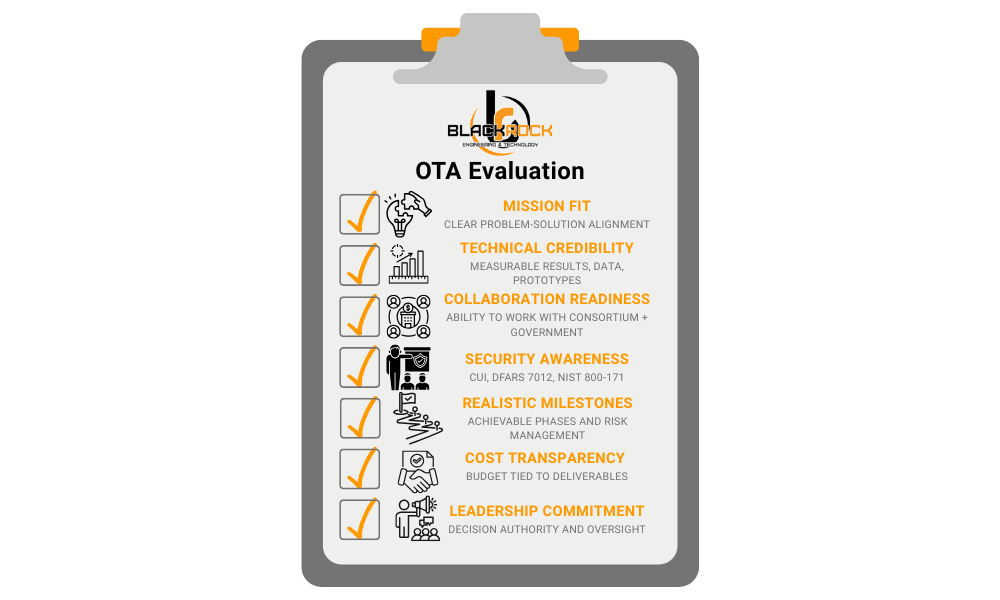
Evaluators Look for Problem-Solution Fit
Every OTA exists to solve a specific problem quickly. Evaluators start by asking: Does this solution clearly address the technical challenge we outlined?
The most competitive proposals connect every capability and feature back to the mission need. They avoid buzzwords and describe how the innovation meets the government’s objectives. The best proposals do not just describe what the technology does; they explain how it will be used in a real-world environment. That demonstrates mission understanding and separates innovators from routine applicants.
They Look for Technical Credibility, Not Marketing Language
An OTA evaluator is often an engineer or program manager. They are not looking for adjectives; they are looking for evidence. Competitive proposals make technical claims measurable.
That means replacing vague statements such as “advanced AI capabilities” with clear, testable facts, such as “the model achieves 97 percent accuracy on baseline detection under field conditions.” If you can back that up with data, prototypes, or performance tests, you build credibility quickly. If your language reads like marketing, you lose it just as fast.
They Look for Clear Collaboration Pathways
OTAs are designed for rapid prototyping and iterative development. Evaluators want to know that you can work well within a consortium or with government engineers. A proposal that highlights openness, data sharing, and agile communication gives reviewers confidence that you will integrate smoothly.
Competitive submissions describe specific collaboration tools, meeting cadences, and review checkpoints. They make the evaluator’s job easier by showing that your team will stay engaged throughout the process.
They Expect Security and Compliance Awareness
Even though OTAs are more flexible than FAR contracts, the data they handle still falls under strict regulations. Reviewers pay close attention to whether your proposal addresses Controlled Unclassified Information (CUI), DFARS 7012 compliance, and NIST 800-171 controls.
Many strong proposals fall short here. They focus on innovation but fail to mention security. The most successful submissions show that security is part of the design, not an afterthought. They describe how data will be protected during prototype development, testing, and transfer.
They Value Realistic Schedules and Milestones
Speed is one of the main advantages of an OTA, but speed without realism signals risk. Evaluators can tell when a schedule is aspirational rather than achievable. Competitive proposals demonstrate momentum and maturity by outlining phased progress rather than overpromising timelines.
A well-structured plan highlights likely risks and your approach to managing them. That foresight builds trust with reviewers who want projects that deliver on time and under control.
They Respect Transparency Around Cost
Unlike fixed-price FAR contracts, OTA budgets are often negotiable. That flexibility gives evaluators more freedom, but it also makes them cautious. They look for transparent cost breakdowns that link each phase of work to tangible deliverables.
The best proposals explain how the requested funding aligns with the expected outcomes. This level of transparency communicates professionalism and helps evaluators justify their recommendations.
They Want to See Leadership Buy-In
An OTA proposal is not just a technical submission; it reflects your organization’s readiness to deliver. Evaluators want to see that leadership understands the mission value and is directly supporting the project.
Including brief leadership bios, escalation paths, and decision authority shows that your organization can act quickly when priorities shift. It signals maturity and accountability, two traits every evaluator values.
They Notice Formatting and Clarity More Than You Think
Evaluators often review dozens of proposals in a short time. The ones that stand out are concise, well-organized, and easy to navigate. Clear headings, logical flow, and consistent formatting go further than flashy graphics or jargon-filled sections.
A competitive proposal reads effortlessly. The easier it is for an evaluator to find your answers, the more likely you are to earn their confidence.
The Bottom Line
A competitive OTA proposal is not the one with the most pages or the lowest price. It is the one that communicates clearly, aligns with the mission, and earns the evaluator’s trust.
From the evaluator’s perspective, clarity equals credibility. When you build your proposal with that mindset, you make their job easier and greatly improve your chances of winning.

If your organization is preparing for an OTA opportunity, download Black Rock’s Tech Modernization Checklist. It will help you assess your systems, verify cybersecurity readiness, and strengthen your next proposal before submission.