
Other Transaction Authority delivery moves quickly, often faster than traditional programs are comfortable with. Systems are built, tested, and iterated in real time while multiple vendors and government stakeholders collaborate closely. In that environment, continuous monitoring is not a compliance checkbox. It is how teams maintain trust, visibility, and momentum while work is actively underway.
Sponsors do not expect perfection during an OTA. They expect awareness. Continuous monitoring is how teams prove they understand what is happening inside their environment as the project evolves.
Continuous Monitoring Is About Awareness, Not Overhead
One of the biggest misconceptions about continuous monitoring is that it requires heavy tooling or constant reporting. During OTA delivery, effective monitoring is focused on maintaining situational awareness without slowing development.
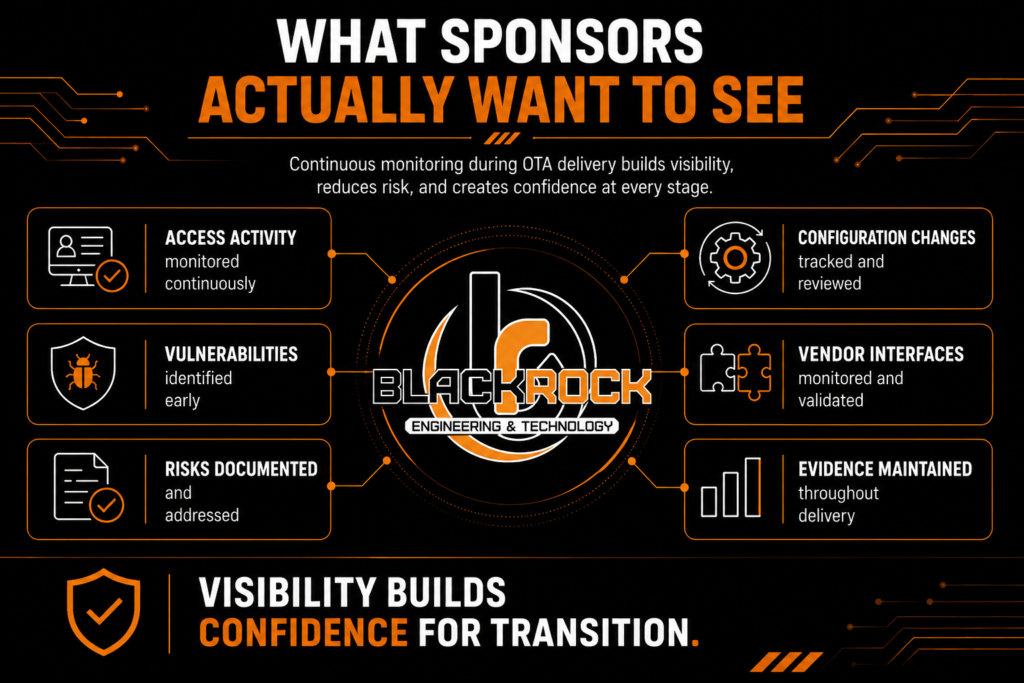
That means tracking system health, access activity, configuration changes, and data movement in near real time. It also means knowing when something changes and being able to explain why. Sponsors care less about dashboards and more about confidence that risks are being identified early, rather than discovered after the fact.
Strong OTA teams monitor what matters most to the mission. They prioritize visibility into environments handling Controlled Unclassified Information, interfaces between vendors, and any system components that would impact delivery timelines or security posture if they failed.
Monitoring Must Align with the Pace of Delivery
OTA projects evolve rapidly, and monitoring practices must keep pace. Static assessments performed at the beginning of a project quickly become outdated. Continuous monitoring adapts as systems are added, modified, or retired.
This often includes automated log collection, vulnerability scanning on a defined cadence, and regular review of access permissions as team members change. It also includes lightweight reporting that shows trends rather than snapshots. Sponsors want to see that issues are being tracked and addressed, not hidden or ignored.
Importantly, continuous monitoring during an OTA should support decision-making. When a risk is identified, teams should be able to quickly adjust architecture, controls, or processes without halting delivery. Monitoring that slows response defeats its purpose.
Continuous Monitoring Builds Confidence for What Comes Next
One of the hidden benefits of continuous monitoring during OTA delivery is how it sets the stage for transition. Whether a project moves into production, a follow-on OTA, or a traditional contract, sponsors will look for evidence that the system has been managed responsibly throughout development.
Teams that can demonstrate ongoing awareness, documented decisions, and consistent risk management make transition discussions easier. They reduce the need for revalidation and remediation later because visibility was maintained all along.
Continuous monitoring also helps teams avoid last-minute scrambles. Instead of rushing to assemble evidence or explain past decisions, they already have a clear operational record that reflects how the system actually behaved during delivery.
The bottom line is that continuous monitoring during OTA delivery is not about slowing innovation. It is about keeping pace with it. Teams that monitor intelligently can move faster because uncertainty is reduced and trust is reinforced.
Next Step
If your organization is delivering under an OTA and wants to improve visibility without adding friction, download Black Rock’s Tech Modernization Checklist. It will help you evaluate monitoring practices, security posture, and readiness for what comes next.