
For defense contractors, few issues are as confusing or as consequential as intellectual property (IP) and data rights under Other Transaction Authority (OTA) agreements.
Unlike traditional FAR-based contracts, OTAs are designed for speed and flexibility. But that freedom comes with tradeoffs. If you don’t clearly define who owns the data or the results of the work, you could lose control of your innovation or create barriers to future business.
Let’s unpack how IP and data rights actually work under OTAs, what the government expects, and what your organization needs to protect before you sign.
Why IP Rights Are Different in OTAs
Under Federal Acquisition Regulations (FAR) contracts, intellectual property ownership and data rights are tightly regulated. The rules spell out what’s considered unlimited rights, government purpose rights, and restricted rights.
In contrast, OTAs are not governed by the FAR. The parties, government, and contractor have broad discretion to negotiate IP and data terms. That means both more opportunity and more risk.
In simple terms:
- You own what you negotiate.
- You lose what you fail to define.
Because the government wants access to use, reproduce, and modify what it funds, every OTA agreement will include a discussion of rights in technical data, computer software, and patents. If your organization doesn’t come to the table with clear positions and documentation, you’re negotiating blind.
The Three Core Categories of Rights
Every OTA agreement should define who has access to what data, and how it can be used:

Most OTA agreements will fall somewhere between government purpose rights and limited rights, depending on funding and contribution levels.
Funding Source Determines Rights
One of the most important tradeoffs in an OTA is the source of funding. The split between government and private funding directly impacts who controls the resulting IP.
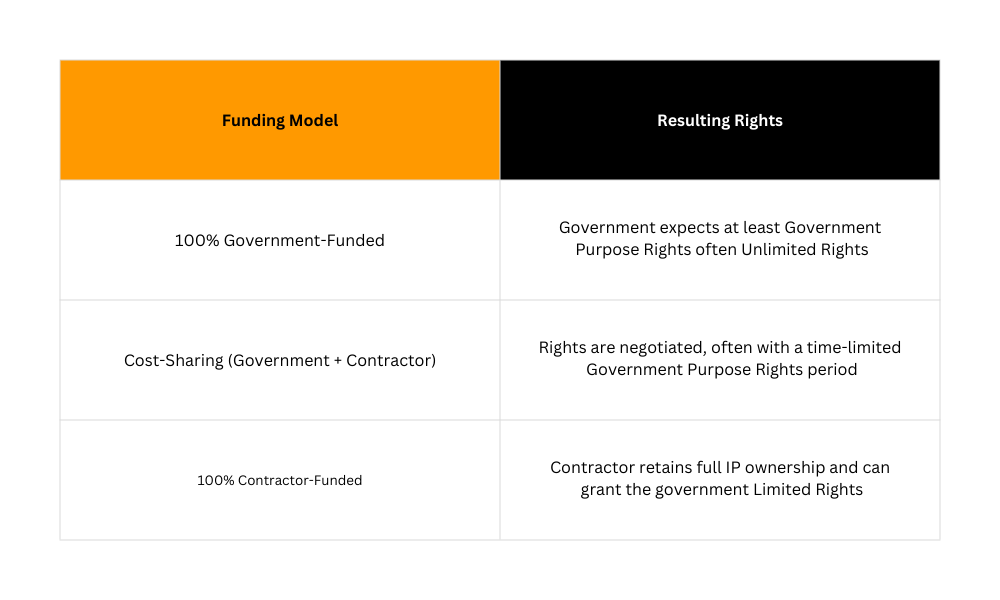
If your organization is investing its own resources in developing technology, be sure the agreement clearly reflects that otherwise, you could unintentionally grant broader rights than intended.
The Most Common Mistakes Contractors Make
- Failing to Document Background IP Many contractors forget to identify the IP and technical data they bring to the project. Without that list, it’s assumed to be government-funded.
- Not Defining Future Commercialization Rights If your goal is to commercialize technology developed under the OTA, you need explicit language protecting your rights to use and sell it outside of DoD programs.
- Overlooking Subcontractor and Vendor Agreements IP rights flow down. If you don’t secure your subcontractors’ IP contributions properly, you may lose leverage during the final agreement.
- Signing Without Counsel Review Because OTAs are flexible, each one is different. Having legal counsel familiar with defense IP law review the agreement is critical.
Negotiating Your IP Position Effectively
To protect your organization’s innovation, use this simple checklist before entering OTA negotiations:
- List all pre-existing (background) IP – including software, algorithms, designs, and documentation.
- Clarify what’s being developed (foreground IP) – and who funds each part.
- Decide what the government can use and for how long – government purpose rights can include sunset clauses.
- Document commercialization plans early – if you plan to sell the product later, retain data rights.
- Ensure subcontractors follow your IP terms – consistency protects the whole project.
This clarity up front prevents disputes later—and ensures innovation benefits both sides.
The Security and Compliance Layer
IP protection doesn’t end at negotiation. Defense contractors must also protect data throughout the project lifecycle under DFARS 252.204-7012 and NIST 800-171. That means secure storage, controlled access, and proper incident reporting.
When you align cybersecurity compliance with IP protection, you build trust with both partners and government customers.
The Bottom Line
OTAs give defense innovators the freedom to move faster—but only if they handle IP and data rights intelligently.
Done well, they allow you to:
- Retain ownership of your technology.
- Speed up delivery without red tape.
- Build lasting partnerships with DoD programs.
Handled poorly, they can cost you your most valuable asset: your intellectual property.
Next Step
If you’re planning to participate in an OTA or join a consortium, download Black Rock’s Tech Modernization Checklist to assess your readiness. It will help you map your systems, secure your data, and prepare to negotiate from a position of strength.
