
When defense innovators want to bring new technology to the mission, the question often comes down to how. The answer usually lies in choosing between a traditional FAR-based contract and an OTA (Other Transaction Authority).
Both are valid, but only one offers the flexibility and speed needed to get innovation from concept to deployment without years of delay. At Black Rock Engineering & Technology, we operate our own OTA to give partners direct access to DoD projects without the barriers of traditional contracting. Understanding the difference is the first step toward choosing the right path for your project.
The Difference Between OTA and FAR
A FAR contract follows the Federal Acquisition Regulation, the government’s formal rulebook for how agencies buy products and services. It ensures competition, accountability, and detailed compliance. These contracts are ideal for large-scale programs, mature systems, and projects that require long-term sustainment.
An OTA, or Other Transaction Authority, is a separate acquisition mechanism that allows the Department of Defense and select agencies to collaborate with private industry outside of the FAR structure. OTAs were designed to encourage innovation and accelerate prototyping by making it easier for nontraditional defense partners to work with the government.
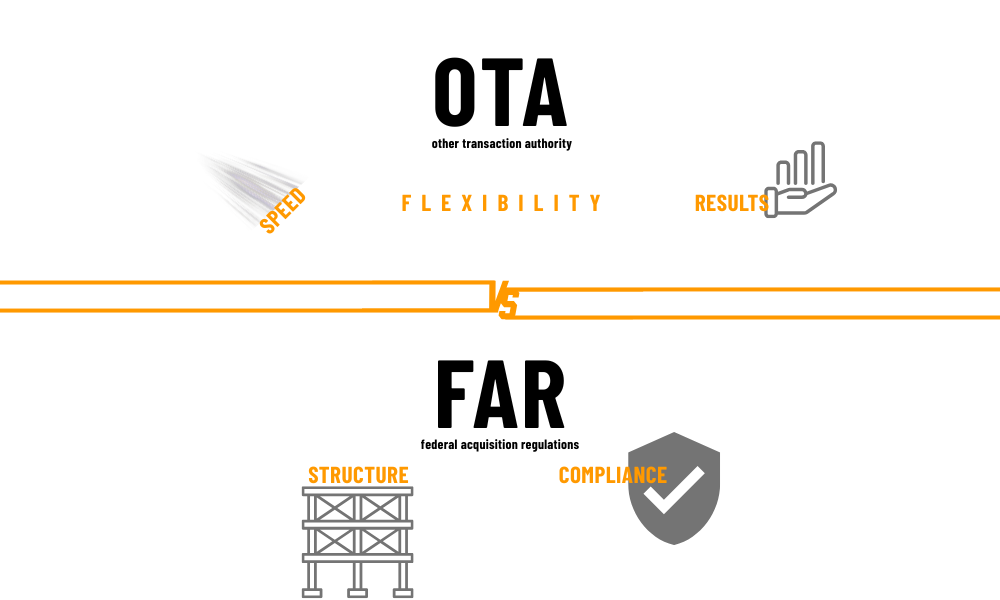
In short, FAR contracts focus on structure and compliance. OTAs focus on flexibility, speed, and results.
Why FAR Contracts Can Slow Innovation
FAR contracts are essential for accountability, but their structure can limit the speed at which new technology reaches the field.
Each phase, from solicitation to award, requires extensive reviews, documentation, and approvals. This process can take months or even years, often leaving emerging solutions behind the pace of technology or mission need.
For established programs with predictable outcomes, the FAR model works well. But for innovation-driven projects or developing technologies, it can slow progress.
How OTAs Accelerate Modernization
OTAs exist to remove those bottlenecks. Through an OTA, the government can partner directly with private industry, startups, universities, and research teams to build, test, and refine new capabilities in real time.
Because FAR clauses do not bind OTAs, they allow flexible negotiation of intellectual property rights, payment terms, and collaboration structures. They are ideal for research, prototyping, and early-stage production.
Projects under an OTA move faster, adapt more easily, and often deliver solutions that align better with mission requirements.
The Black Rock OTA Advantage
Black Rock Engineering & Technology operates an active, government-recognized OTA that brings together proven defense partners and innovative technology companies. Joining the Black Rock OTA allows participants to:
- Access DoD prototyping and modernization opportunities faster
- Collaborate directly on funded federal projects without full FAR restrictions.
- Work within a trusted, compliant, Service-Disabled Veteran-Owned Small Business framework
- Leverage Black Rock’s expertise in cybersecurity, compliance, and digital modernization.
- Focus on delivering solutions instead of managing complex acquisition paperwork.
Our OTA exists to accelerate modernization for the DoD and its partners. We handle the regulatory and compliance side so our members can stay focused on performance, innovation, and mission readiness.
When a FAR Contract Still Makes Sense
There are times when a traditional contract is the better fit. Programs that require long-term sustainment, large-scale production, or highly structured oversight still benefit from the rigor of FAR contracting.
In many cases, the best strategy is to start with an OTA for early research and prototyping, then transition into a FAR contract once the solution is proven and ready for full-scale deployment. Black Rock helps partners navigate that full lifecycle, ensuring a seamless handoff from prototype to production.
The Bottom Line
Both FAR contracts and OTAs have their place. The choice depends on your technology’s maturity, your risk tolerance, and your timeline.
If your organization builds innovative solutions and wants to engage with DoD projects quickly and efficiently, joining the Black Rock OTA is the most direct path.

Schedule a call today with our team to learn how to become part of the Black Rock OTA consortium and start collaborating on real defense modernization programs.
Appendix / References
- DoD “Other Transactions Guide” (2023) (acq.osd.mil)
- Federal Acquisition Regulation, 48 CFR Chapter 1 (acquisition.gov)
- DAU – Other Transactions for Prototype Projects Execution Guide (dau.edu)
- CRS – Defense Primer: Other Transaction Authority (crsreports.congress.gov)
- MITRE AiDA – OTA Overview and Statutory Limits (aida.mitre.org)