Other Transaction Authority (OTA) agreements have become one of the most powerful tools in defense acquisition. They allow the Department of Defense and its partners to develop and prototype technology faster than traditional Federal Acquisition Regulation (FAR) contracts ever could. Yet for all their flexibility, OTAs come with challenges that can trip up even experienced contractors.
Many organizations jump into an OTA opportunity expecting speed and simplicity, only to find confusion, unclear roles, and compliance surprises. Understanding these common pitfalls and how to avoid them can help your organization deliver value faster while protecting your interests.
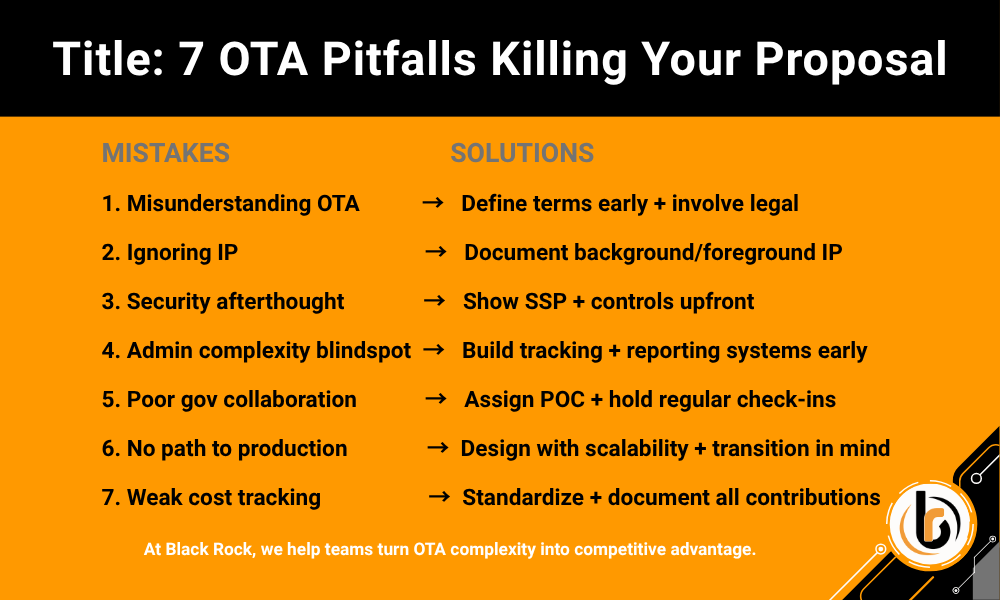
1. Misunderstanding What an OTA Really Is
The first mistake many teams make is assuming an OTA is just a simplified version of a FAR contract. It is not. OTAs operate outside the FAR system, which means fewer rules but also less structure.
That flexibility is a double-edged sword. Without standard templates or oversight, participants must define everything clearly: intellectual property rights, data rights, deliverables, and evaluation methods. If your team assumes those details are implied, you are already at risk.
How to avoid it:
Bring legal and compliance staff into the process early. Treat the OTA as a unique instrument, not a shortcut, and make sure every clause is reviewed before signing.
2. Ignoring Data Rights and IP Protections
Because OTAs are designed to encourage innovation, intellectual property issues come up quickly. The government expects access to what it funds, but contractors must protect what they develop independently.
The most common pitfall is failing to properly document background IP and foreground IP. Without that clarity, ownership can later be disputed, especially when prototypes move into production.
How to avoid it:
Define who owns what before work begins. Include IP schedules that clearly identify pre-existing technology, new deliverables, and any licensing or rights of use.
3. Treating Security as an Afterthought
Many companies treat cybersecurity as a compliance box to check later. In OTA projects, this approach is a deal-breaker. Sponsors expect a documented security posture from day one.
Failing to protect Controlled Unclassified Information (CUI) or to meet minimum DFARS 7012 and NIST 800-171 controls can lead to delays or disqualification. Even though OTAs allow flexibility, the government still holds participants accountable for protecting sensitive data.
How to avoid it:
Integrate cybersecurity early in your proposal and planning stages. Include your System Security Plan (SSP), a summary of implemented controls, and evidence of how data will be protected during development and testing.
4. Underestimating Administrative Complexity
Many contractors assume OTAs are paperwork-free. While the contracting process is simpler, the reporting, financial tracking, and deliverable management can still be demanding.
Program managers and auditors may request documentation that mirrors traditional contracts once a project scales. If your internal systems are not prepared for that level of reporting, it can create friction and slow down performance.
How to avoid it:
Establish strong internal project management and compliance documentation processes from the start. Use tools like Keap or other automation systems to organize deliverables and maintain audit-ready records.
5. Failing to Collaborate Effectively with the Government Team
OTAs are built for collaboration. Yet some organizations treat them like fixed contracts, maintaining distance from government engineers and program managers. That can undermine trust and reduce your ability to influence project direction.
Evaluators and contracting officers want to see vendors who communicate proactively, share updates transparently, and respond quickly to change.
How to avoid it:
Assign a single point of contact for government communication. Hold short, recurring check-ins with project stakeholders and document decisions clearly. Doing this creates a record of trust and reliability.
6. Not Planning for the Transition from Prototype to Production
One of the biggest missed opportunities in OTA projects is failing to think ahead. Winning a prototype phase is exciting, but success depends on how easily you can transition that prototype into production.
If your IP, documentation, and cost structures are not set up for scalability, you may find yourself unable to capitalize on what you built.
How to avoid it:
Design every prototype as if it will move to production. Maintain traceable documentation, version control, and quality standards that support a seamless handoff to follow-on contracts.
7. Neglecting to Track Funding and Cost-Sharing Accurately
In cost-sharing OTAs, transparency in funding is critical. Misreporting contributions or using vague cost-tracking methods can lead to compliance issues or disputes over deliverables.
How to avoid it:
Keep a clear record of government and company contributions. Use simple, standardized cost documentation formats and make them accessible to all stakeholders.
The Bottom Line
OTAs are powerful instruments for innovation, but their flexibility demands maturity. Success depends on clarity, documentation, and communication. The organizations that win consistently under OTAs are not just the most innovative, they are the most disciplined.
If you approach each OTA as a partnership rather than a transaction, you will avoid costly missteps and build a stronger reputation with sponsors and evaluators.
Next Step
Before submitting your next OTA proposal, download Black Rock’s Tech Modernization Checklist. It will help you verify that your systems, data protections, and readiness plans meet the expectations of modern defense sponsors.