Other Transaction Authority agreements are often described as flexible or lightweight compared to traditional government contracts. That description is partly true, but it can be misleading. OTAs reduce acquisition friction, not accountability. During delivery, sponsors still expect clear evidence that systems, data, and processes are being managed responsibly.
The key difference is not whether compliance artifacts are required. It is which artifacts matter and how they are maintained while work is moving quickly.
OTAs Change the Format, Not the Expectation
One of the most common misconceptions about OTAs is that formal compliance documentation can be put off until later. In reality, sponsors still expect teams to demonstrate control over security, data handling, and operational risk throughout delivery.
Most OTA efforts that handle Controlled Unclassified Information still require alignment with DFARS 252.204-7012 and NIST SP 800-171. That means certain core artifacts remain relevant even if they are lighter or less formal than those required under FAR contracts.
At a minimum, sponsors expect a clear System Security Plan or equivalent summary that explains how systems are protected. They also expect evidence that any known gaps are tracked and addressed, typically through a Plan of Action and Milestones. These documents do not need to be exhaustive, but they must reflect reality.
Policies and procedures still matter. Access control, incident response, data handling, and change management processes should be documented clearly enough that a sponsor can understand how risks are managed day to day. Verbal assurances are rarely sufficient once delivery is underway.
Evidence Matters More Than Paper
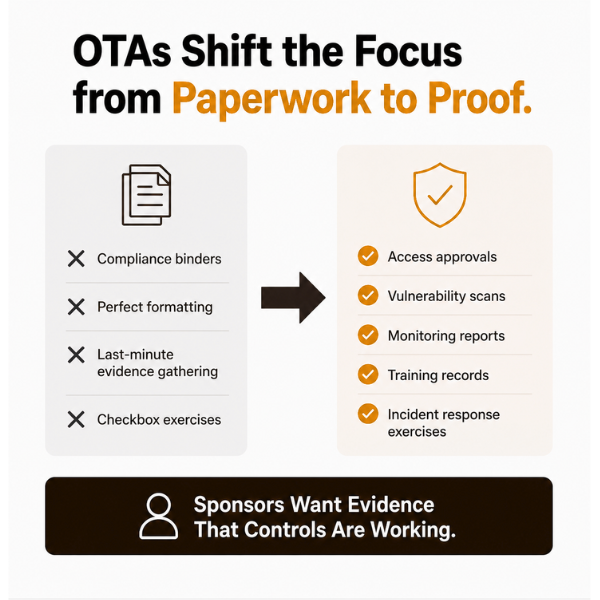
During an OTA, sponsors are often less concerned with perfectly formatted documents and more concerned with operational evidence. They want to see that controls are being used, not just written down.
That includes records of access approvals, training completion, vulnerability scans, and incident response exercises. It also includes logs or reports that demonstrate consistent monitoring. These artifacts demonstrate that compliance is part of daily operations, not something assembled at the end of the project.
Another area that often gets overlooked is vendor and subcontractor documentation. When multiple partners are involved, sponsors expect evidence that security expectations are being appropriately cascaded. This may include subcontractor attestations, access agreements, or summaries of their security posture.
Finally, documentation should support transition. Whether the project moves into production, a follow-on OTA, or a traditional contract, sponsors will look back at how the system was managed during delivery. Teams that maintain accurate, current artifacts reduce friction later because they do not need to recreate history.
The bottom line is that OTAs do not eliminate compliance artifacts. They shift the focus from paperwork to proof. Teams that maintain the right artifacts throughout delivery move faster because they are never scrambling to explain how controls were applied.
Next Step
If you are delivering under an OTA and want to confirm you have the right documentation in place, download Black Rock’s Tech Modernization Checklist. It will help you assess compliance artifacts, monitoring practices, and transition readiness.