
Other Transaction Authority work is often designed to move faster than traditional programs. That speed is valuable, but it can create problems later if teams do not think ahead. Many organizations treat OTA delivery as a separate effort, only to discover that systems built during prototyping do not align cleanly with future Authority to Operate or CMMC requirements.
Sponsors increasingly expect OTA projects to lay the groundwork for what comes next. Alignment is not about overengineering the prototype. It is about making smart decisions early so progress is not lost later.
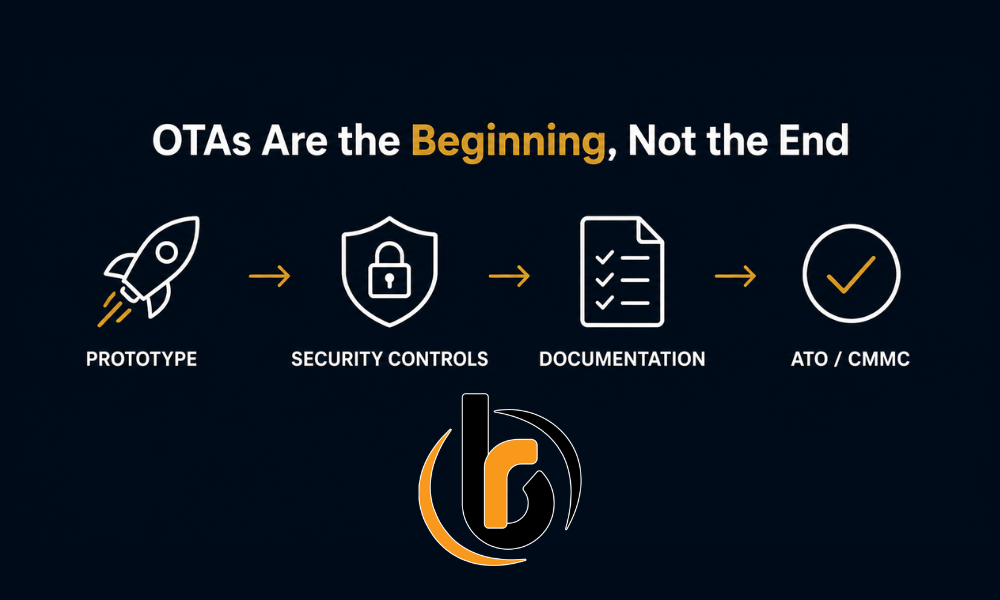
OTAs Are the Foundation, Not a Detour
A common misconception is that OTA work lives outside the compliance lifecycle. In reality, OTAs are often the first step toward production systems that will require an ATO or CMMC certification. When teams ignore that reality, they create rework, delays, and added cost.
Alignment starts with understanding which frameworks will apply later. If a system is likely to handle Controlled Unclassified Information in production, NIST SP 800-171 requirements should influence design decisions during the OTA. This does not mean full compliance must be achieved immediately, but it does mean controls should be considered early.
Teams that succeed make architectural choices with future requirements in mind. They select platforms, tools, and processes that can scale into ATO and CMMC environments without being replaced.
Build Evidence While You Build Capability
One of the easiest ways to align OTA work with future compliance is to capture evidence as it happens. Instead of treating documentation as a separate phase, teams maintain lightweight records of decisions, controls, and configurations throughout delivery.
This includes maintaining a System Security Plan or equivalent summary that evolves with the system. It also includes tracking gaps and mitigation plans in a simple Plan of Action and Milestones. When these artifacts are in place early, the transition to ATO or CMMC becomes incremental rather than disruptive.
Continuous monitoring during the OTA also plays a key role. Logging, access reviews, vulnerability scans, and configuration tracking provide proof that controls are operating. That operational evidence often carries forward into formal assessments.
Vendor and subcontractor alignment matters here as well. If partners are part of the OTA, their security posture and data handling practices should be documented. Future ATO and CMMC reviews will look at the entire ecosystem, not just the prime contractor.
The bottom line is that OTAs should accelerate readiness, not postpone it. Teams that align design, controls, and documentation early move into ATO or CMMC assessments with confidence instead of urgency.
Next Step
If your organization is using an OTA as a stepping stone to production, download Black Rock’s Tech Modernization Checklist. It will help you assess whether your current work aligns with future ATO and CMMC expectations.