
For many CISOs, digital modernization feels like a constant tradeoff between speed and risk. Legacy systems need to be replaced, new capabilities must be delivered faster, and compliance expectations continue to rise. Other Transaction Authority agreements offer a way to break that tension, but only if they are used intentionally.
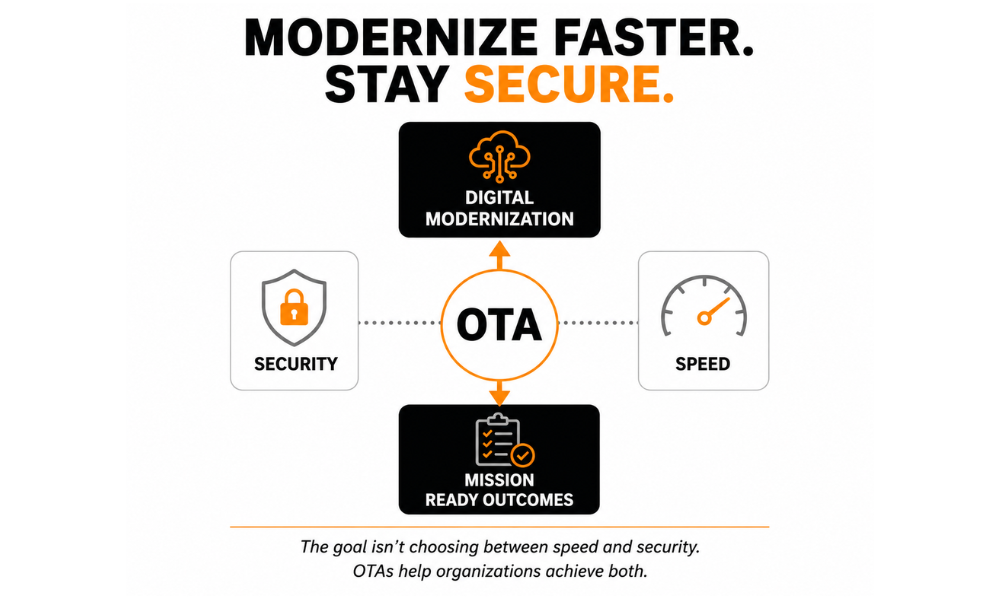
OTAs allow CISOs to modernize systems faster than traditional acquisition paths allow. At the same time, they introduce new risks if security and governance are not embedded early. The difference between success and disruption comes down to how CISOs engage with the OTA from the start.
OTAs Give CISOs a Seat at the Modernization Table
One of the biggest advantages of OTAs is flexibility. Because rigid FAR structures do not bind OTAs, CISOs can influence architecture, tooling, and security decisions much earlier than they can in traditional programs. This allows security to shape modernization rather than react to it.
When CISOs engage early, they can guide teams toward cloud platforms, identity systems, and monitoring tools that support both innovation and long-term compliance. This avoids the common pattern of building fast during prototyping and then rebuilding later to meet security requirements.
OTAs also allow CISOs to test modernization approaches in smaller, lower-risk phases. Instead of committing to a full system overhaul, teams can validate architectures, controls, and integrations incrementally. That phased approach reduces risk while still delivering momentum.
Safe Acceleration Comes from Design, Not Control
Accelerating modernization safely does not mean adding layers of approval or slowing delivery. It means designing systems that are secure by default and observable from the beginning.
CISOs can use OTAs to require basic security guardrails, such as identity-based access controls, environment segmentation, logging, and configuration management. These controls do not limit innovation. They create a stable foundation that allows teams to move faster without losing visibility.
OTAs also make it easier to align modernization with future requirements. When systems are designed with NIST 800-171, ATO, and CMMC expectations in mind, CISOs avoid rework later. Evidence collected during OTA delivery often becomes the starting point for formal assessments.
Vendor selection plays a major role here as well. OTAs often bring in new partners quickly. CISOs who evaluate vendors based on data exposure, security maturity, and operational readiness protect the modernization effort from unnecessary risk.
The most successful CISOs treat OTAs as a modernization accelerator, not a shortcut. They use flexibility to move faster while maintaining accountability.
The bottom line is that OTAs enable CISOs to lead modernization rather than chase it. When security is embedded into design, tooling, and partnerships, modernization can move quickly without sacrificing trust or mission readiness.
Next Step
If you are exploring OTAs as part of your modernization strategy, download Black Rock’s Tech Modernization Checklist. It will help you assess whether your systems, vendors, and controls are ready to scale safely.