
Compliance reporting is one of the most time-consuming and least strategic activities in regulated environments. Security teams spend countless hours gathering evidence, updating spreadsheets, responding to requests, and recreating documentation that already exists in multiple systems. The work is necessary, but it rarely advances the mission.
Automating compliance reporting changes that dynamic. Instead of compliance being a recurring drain on time and budget, it becomes a byproduct of how systems operate. The return on investment is not theoretical. It shows up in reduced labor, faster audits, and better decision-making.
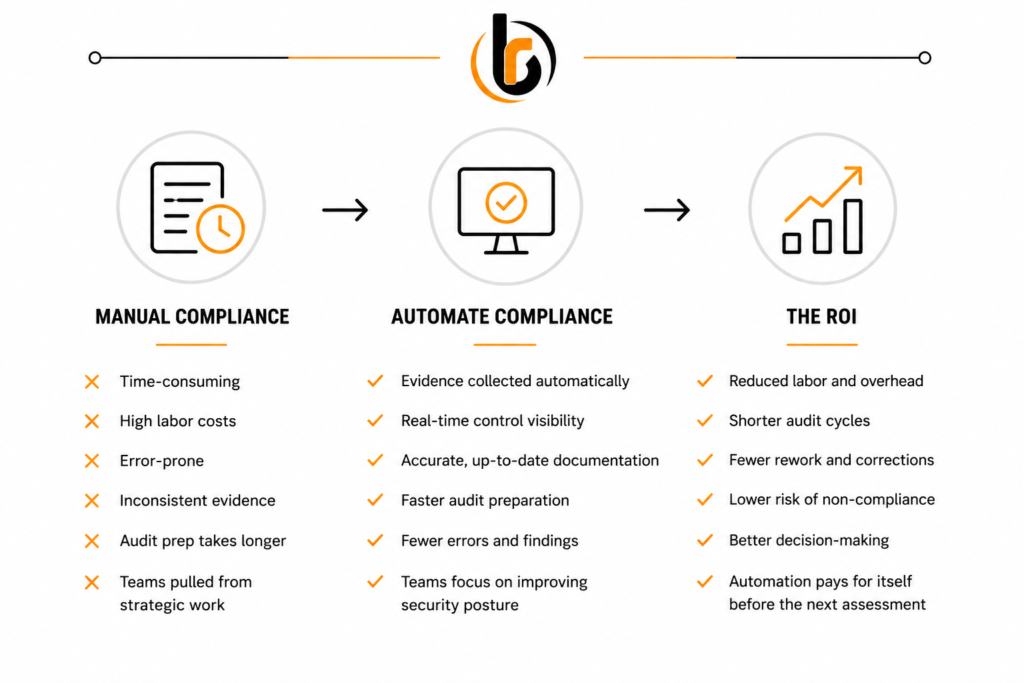
Manual Compliance Creates Hidden Costs
The true cost of manual compliance reporting is rarely visible on a budget line. It appears in staff burnout, delayed projects, and inconsistent evidence. Engineers and security leaders are pulled away from modernization and risk reduction to assemble reports under deadline pressure.
Manual processes also introduce errors. Evidence goes stale, controls drift, and teams lose confidence in their own documentation. When audits or sponsor reviews arrive, organizations scramble to reconcile gaps that have existed for months.
These hidden costs compound over time. What feels manageable early eventually becomes a bottleneck that slows modernization and increases risk.
Automation Turns Compliance into Continuous Visibility
Automated compliance reporting changes compliance from a periodic event into a continuous process. Evidence is collected directly from systems as they operate. Control status is visible in real time. Documentation reflects reality instead of assumptions.
This visibility reduces effort across the organization. Teams spend less time chasing screenshots and more time improving security posture. Audit preparation shrinks because evidence already exists. Findings decrease because issues are identified earlier.
Automation also improves decision-making. Leaders can see where controls are weak, where risk is increasing, and where investment is needed. Compliance stops being reactive and starts supporting modernization and governance.
The ROI becomes clear when teams calculate the hours saved, the audit cycles shortened, and the rework avoided. In many environments, automation pays for itself well before the next assessment.
The bottom line is that automating compliance reporting is not about replacing people. It is about allowing people to focus on work that actually reduces risk and advances the mission.
Next Step
If your organization spends more time reporting on compliance than improving it, download Black Rock’s Tech Modernization Checklist. It will help you evaluate where automation can reduce effort, cost, and risk.
