
CMMC 2.0 has moved from a future concern to an operational reality. For CISOs, the question is no longer whether an audit will happen, but whether the organization will be ready when it does. The difference between a smooth assessment and a painful one rarely comes down to intent. It comes down to preparation, clarity, and operational discipline.
CMMC audit prep is not a documentation exercise. It is a test of how well security, technology, and operations actually function together. Assessors are not looking for perfect language. They are looking for proof that controls are implemented, used consistently, and supported by objective evidence.
What CISOs Must Understand About CMMC Audits
CMMC 2.0 aligns closely with NIST SP 800 171, which means many organizations are already familiar with the control requirements. What has changed is enforcement and accountability. Attestations matter. Evidence matters. Inconsistent implementation is no longer something teams can explain away.
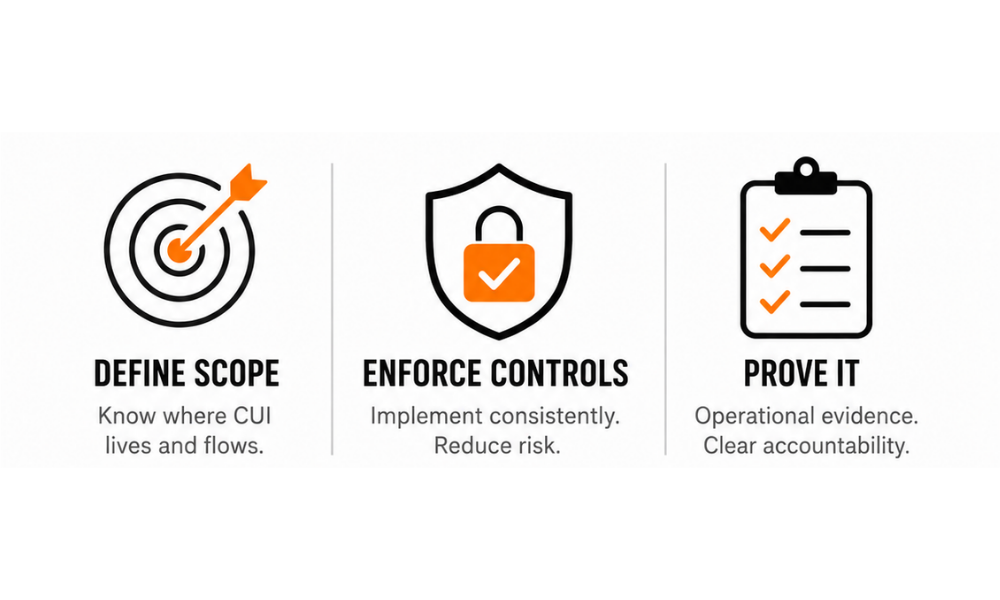
The most common failure point CISOs encounter is scope confusion. Organizations underestimate how broadly Controlled Unclassified Information flows through their environment. Email systems, shared file platforms, endpoints, backup systems, logging tools, and third-party access all quickly expand the scope. If the scope is not clearly defined and defensible, every control becomes harder to manage, and every audit becomes more expensive.
The second major failure point is evidence readiness. Many organizations have controls that exist in theory but are difficult to prove in practice. Evidence lives in screenshots, personal folders, or outdated spreadsheets. When assessors ask for proof, teams scramble to recreate what should already exist.
CISO leadership is critical because these problems are not technical alone. They are operational.
How CISOs Should Structure Audit Preparation
Strong CMMC prep begins with a clear, security-led scoping decision. CISOs must be directly involved in determining where CUI enters the environment, where it is processed, where it is stored, and who can access it. This often leads to an important architectural decision. Either build a well-defined, compliant enclave or intentionally bring broader enterprise systems into scope. Both approaches can work. What fails is ambiguity.
Once the scope is defined, focus shifts from policies to behavior. A System Security Plan must reflect reality, not aspiration. CISOs should push for a short list of non-negotiable controls across the scoped environment. These typically include enforced multifactor authentication, role-based access, disciplined privileged access, centralized logging, protected backups, time synchronization, and consistent change management. These controls do more than reduce risk. They generate evidence naturally.
Evidence strategy is where many organizations fall behind. CISOs should treat evidence like a security capability. Decide in advance what evidence will be produced for high-risk control areas, where it will live, who owns it, and how quickly it can be retrieved. Evidence should come from systems of record such as identity platforms, ticketing systems, SIEM tools, vulnerability scanners, and backup systems. When evidence is operational, audits become confirmation rather than investigation.
Plans of Action and Milestones should be handled carefully. While some pathways allow limited gaps, CISOs should avoid strategies that rely on near-compliance. Each open item increases audit risk and operational distraction. Leadership should clearly understand what gaps exist, why they exist, and how quickly they will be closed.
Vendor and subcontractor alignment is another critical factor. Any third party that touches CUI or scoped systems affects audit readiness. CISOs should ensure access is limited, monitored, and documented. Even when vendors are not directly assessed, their behavior can undermine your evidence and the consistency of your controls.
Finally, preparation must be tested. A mock assessment should stress-test both people and processes. Can system owners explain how controls work without contradicting each other? Can evidence be produced quickly without heroics? If answers take days, readiness is low. If answers take minutes and feel routine, the organization is close.
What Audit Ready Actually Looks Like
Audit-ready does not mean perfect. It means scope is crisp, controls are consistently enforced, evidence is operational, and teams understand their responsibilities. It means assessors hear the same story from leadership, engineers, and administrators. It means compliance is part of daily operations, not an event.
This level of readiness does not happen by accident. It requires coordination across security, IT, engineering, and leadership. It also requires experience. CISOs who try to navigate this alone often lose time solving problems others have already solved.
If you are a CISO preparing for a CMMC audit or unsure whether your current posture would hold up under assessment, now is the time to act.
Schedule a call with Black Rock Engineering and Technology. Our team works directly with CISOs to define scope, stabilize controls, operationalize evidence, and prepare organizations for real-world assessments, not just checklists.
A short conversation now can save months of rework, stress, and risk later.